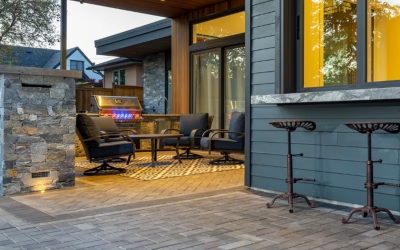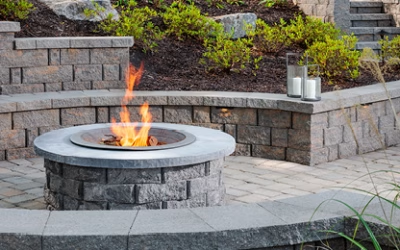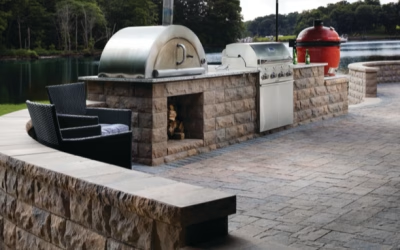
If you are researching a new outdoor surface, one of the first questions is simple: how long do pavers last? For most homeowners, the honest answer is decades, not just years. Industry and manufacturer sources consistently describe properly installed interlocking concrete pavers as long-lasting surfaces, with CMHA noting they provide an attractive surface for decades, This Old House describing concrete pavers as lasting for decades even in harsh climates, and real-world case studies showing heavily trafficked paver installations still performing more than 30 years later.
A practical way to think about paver lifespan is this: a well-built residential paver driveway often lands in the 30- to 40-year range, and patios can last at least that long and often longer because they usually do not carry repeated vehicle loads. That said, the pavers themselves are rarely the weak point. Unilock explicitly says the biggest enemy of concrete pavers is poor installation, not the paving units. In other words, the answer is less about the block on top and more about the base, drainage, edge restraint, and upkeep underneath and around it.
Average paver lifespan: patios vs driveways
For patio paver durability, lighter use is a major advantage. Patios deal mostly with foot traffic, furniture, and occasional grills or planters, so they are not under the same stress as a driveway. When concrete pavers are properly installed and maintained, they are described as lasting for decades, and some manufacturers frame the units themselves as lifetime products. (This Old House)
For paver driveway longevity, the expectations are still strong, but the design margin matters more. Driveways carry daily vehicle loads, turning forces, and more edge stress. CMHA explains that pavers behave as a semi-flexible pavement system that shares load between neighboring units, which is one reason they perform well under traffic and in freeze-thaw environments. This Old House says paver driveways can last 30 to 40 years with proper installation and maintenance.
So, if you want the quick planning number, a Boise homeowner should think like this: a paver patio should last for decades, and a paver driveway should also last for decades when it is built for traffic, drainage, and winter conditions from the start. (This Old House)
What affects paver lifespan the most?
- Base preparation and compactionThis is the biggest factor by far. Unilock says proper excavation, correct fill, grading, and compaction are critical, and poor installation can lead to shifting, cracking, drainage problems, and erosion beneath the pavers.
- Drainage and moisture controlWater is where long-lasting projects separate from short-lived ones. CMHA emphasizes freeze-thaw durability standards for interlocking concrete pavers.
- Material qualityCMHA notes ASTM C936 standards for durability.
- Traffic load and layoutCMHA explains load distribution and interlock performance.
- Joint sand and edge restraintBelgard notes polymeric sand improves stability and reduces washout.
Boise climate considerations
Boise has a semi-arid climate with most moisture falling between November and May. National Weather Service data highlights freeze-thaw exposure and winter precipitation patterns.
These conditions stress pavement systems through wetting, freezing, and thawing cycles.
CMHA notes pavers are semi-flexible compared to rigid slabs.
How maintenance changes patio paver durability
CMHA recommends seasonal maintenance.
Routine care includes cleaning, drainage checks, and joint maintenance.
Unilock notes sealing is optional and mainly aesthetic.
Belgard advises using paver-safe de-icing products.
Repairability vs concrete: where pavers usually win
CMHA explains pavers distribute loads and remain functional with minor movement.
Repairs are modular and localized.
Belgard confirms individual paver replacement is simple compared to concrete repairs.
Final takeaway
In Boise, a properly installed paver system should last for decades. (CMHA)
Want a patio or driveway built for Boise’s freeze-thaw conditions instead of just a fast install? Paver Pros Boise can evaluate grading, drainage, traffic load, and long-term maintenance needs, then recommend a system designed to last. Request a Quote or Book a Design Consultation to get a lifespan-focused plan for your project.
Need help deciding whether permeable pavers are the right drainage fix for your patio, driveway, or walkway?
Contact Paver Pros Boise for a drainage-focused site evaluation that looks at slope, runoff sources, soil conditions, and the best hardscape system for your property.