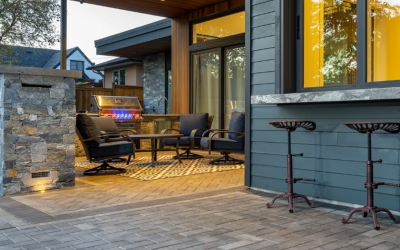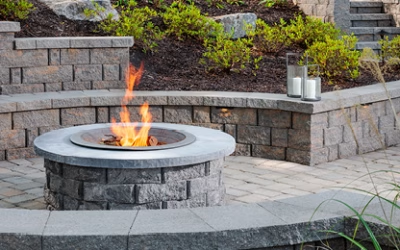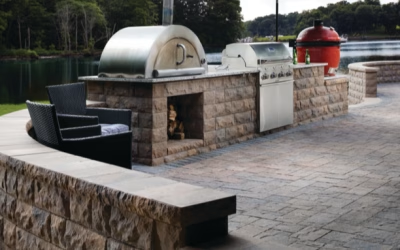
If you are researching a new outdoor surface, one of the first questions is simple: how long do pavers last? For most homeowners, the honest answer is decades, not just years. Industry and manufacturer sources consistently describe properly installed interlocking concrete pavers as long-lasting surfaces, with CMHA noting they provide an attractive surface for decades, This Old House describing concrete pavers as lasting for decades even in harsh climates, and real-world case studies showing heavily trafficked paver installations still performing more than 30 years later. (CMHA)
A practical way to think about paver lifespan is this: a well-built residential paver driveway often lands in the 30- to 40-year range, and patios can last at least that long and often longer because they usually do not carry repeated vehicle loads. That said, the pavers themselves are rarely the weak point. Unilock explicitly says the biggest enemy of concrete pavers is poor installation, not the paving units. In other words, the answer is less about the block on top and more about the base, drainage, edge restraint, and upkeep underneath and around it. (This Old House)
Average paver lifespan: patios vs driveways
For patio paver durability, lighter use is a major advantage. Patios deal mostly with foot traffic, furniture, and occasional grills or planters, so they are not under the same stress as a driveway. When concrete pavers are properly installed and maintained, they are described as lasting for decades, and some manufacturers frame the units themselves as lifetime products. (This Old House)
For paver driveway longevity, the expectations are still strong, but the design margin matters more. Driveways carry daily vehicle loads, turning forces, and more edge stress. CMHA explains that pavers behave as a semi-flexible pavement system that shares load between neighboring units, which is one reason they perform well under traffic and in freeze-thaw environments. This Old House says paver driveways can last 30 to 40 years with proper installation and maintenance. (CMHA)
So, if you want the quick planning number, a Boise homeowner should think like this: a paver patio should last for decades, and a paver driveway should also last for decades when it is built for traffic, drainage, and winter conditions from the start. (This Old House)
What affects paver lifespan the most?
1) Base preparation and compaction
This is the biggest factor by far. Unilock says proper excavation, correct fill, grading, and compaction are critical, and poor installation can lead to shifting, cracking, drainage problems, and erosion beneath the pavers. That is why two patios made with the same paver can have very different lifespans. (Unilock)
2) Drainage and moisture control
Water is where long-lasting projects separate from short-lived ones. If water sits on the surface, runs under the edge, or saturates the base, the system is more likely to settle, lose interlock, or move during freezing weather. CMHA’s technical resources emphasize that interlocking concrete pavers are built around standards that include freeze-thaw and de-icing salt durability, which matters in climates where moisture and freezing overlap. (CMHA)
3) Material quality
Not every paver is equal. CMHA notes ASTM C936 references freeze-thaw and de-icing salt durability testing for interlocking concrete paving units. In practical terms, that means product quality matters, especially for driveways and winter-exposed surfaces. A bargain paver on a weak base is not a long-term value. (CMHA)
4) Traffic load and layout
Driveways need more than “pretty pavers.” They need a system designed for cars, turning forces, and edge restraint. CMHA explains that pavers transfer loads across neighboring units, and case-study documentation highlights the importance of base compaction, proper drainage, edge restraints, and interlocking patterns for long-term performance under traffic. (CMHA)
5) Joint sand and edge restraint
Pavers last because they work as a system. The joints help the units lock together, and the perimeter keeps them from spreading. If joints wash out or edges fail, the surface can begin to loosen and shift. Belgard notes polymeric sand can improve stability and help reduce weeds and insects in joints, while CMHA’s construction and maintenance resources emphasize jointing as part of pavement performance. (Belgard)
Boise climate considerations
Boise adds an important twist to this conversation. The city has a semi-arid, high-desert climate, averaging just over 11 inches of rain and melted snow per year at the airport, but roughly three quarters of that moisture falls between November and May. The National Weather Service also notes that Boise has a high frequency of overnight winter precipitation, often creating early-morning surfaces covered in ice, snow, rain, or a mix of all three. Boise’s 1991–2020 normal snowfall is 17.59 inches. (National Weather Service)
That means Boise is not a “set it and forget it” market for hardscapes. Summers are dry, but winter and shoulder-season conditions still test a pavement system. Repeated wetting, freezing, thawing, and occasional de-icing products can expose poor grading, shallow base prep, weak edges, or drainage shortcuts. In Boise, long-term paver driveway longevity is usually won below the surface first. (National Weather Service)
This is also why pavers tend to outperform rigid slabs in local conditions where minor ground movement happens. CMHA explains that concrete slabs are rigid, while pavers are semi-flexible and better able to maintain function when small movement occurs. That flexibility is a real advantage when winter moisture and freezing are part of the equation. (CMHA)
How maintenance changes patio paver durability
Maintenance does not rescue a bad install, but it absolutely protects a good one. CMHA recommends routine preventive maintenance in the spring and fall, which is a smart fit for Boise because those are the seasons when debris, moisture movement, and temperature swings tend to expose small issues before they become expensive ones. (CMHA)
Good maintenance is straightforward: keep the surface clean, keep drainage routes open, watch for low spots after winter, replenish joint material as needed, and repair isolated settlement early. Small maintenance tasks preserve interlock and reduce the odds that water starts working into the system. CMHA also notes that properly installed interlocking concrete pavements are low-maintenance surfaces, not no-maintenance surfaces. (CMHA)
Sealing is worth discussing because homeowners often overestimate its role. Unilock says pavers are highly durable with or without sealer, and that sealing is optional for color enhancement or stain protection. If you do seal, Unilock recommends expecting reapplication every 3 to 5 years. That means sealing is mainly an appearance and stain-management decision, not the core reason a paver system lasts structurally. (Unilock)
Winter care matters too. Belgard warns that the wrong de-icing products can make hardscapes degrade faster, so Boise homeowners should use only paver-safe products approved by their installer or manufacturer rather than assuming every ice melt is safe. (Belgard)
Repairability vs concrete: where pavers usually win
This is where pavers often separate themselves from slab concrete over the long haul.
CMHA notes that when poured concrete cracks, it loses its ability to transfer loads across the damaged area and can deteriorate more quickly. Pavers, by contrast, can continue functioning even when minor movement occurs, because the system distributes loads across multiple units. In freeze-thaw regions or on soils that move a bit over time, that is a meaningful performance advantage. (CMHA)
Repairs are also much simpler. CMHA explains that affected pavers can be removed, the bedding or base adjusted, and the same pavers reinstalled, often with little visible evidence of repair. Belgard makes the same point from a homeowner angle: if a single paver is damaged, it can be replaced without removing an entire section. With concrete, repairs usually mean saw-cutting, demolition, disposal, repouring, and waiting for cure time—often with a patch that does not visually match. (CMHA)
That modular repairability matters in real life. If a sprinkler line leaks, a utility needs access, a tree root causes lift, or a small area settles after a Boise winter, pavers are usually a repair problem rather than a full replacement problem. That can lower lifecycle disruption and preserve the look of the original installation far better than patching a slab. (CMHA)
Final takeaway
So, how long do pavers last? In Boise, the best answer is that a quality paver patio or driveway should last for decades, and the best installations can keep going much longer. The real determinants are installation quality, drainage, traffic design, winter exposure, and consistent maintenance. If those pieces are handled correctly, patio paver durability and paver driveway longevity are usually stronger than homeowners expect, especially when compared with the repair limitations of poured concrete. (CMHA)
How long do paver patios last?
A properly installed paver patio should generally last for decades. Industry and manufacturer sources consistently describe concrete pavers as long-lasting, and lighter-use patio surfaces often avoid the heavier stress that shortens driveway life. (CMHA)
How long do paver driveways last?
A paver driveway often lasts around 30 to 40 years with proper installation and maintenance, and sometimes longer when drainage, compaction, and winter care are handled well. (This Old House)
Are pavers better than concrete in Boise’s climate?
They can be a better long-term fit for many Boise projects because pavers are semi-flexible, handle minor movement better than rigid slabs, and are easier to repair after freeze-thaw-related settling or localized damage. (CMHA)
Do pavers need to be sealed?
Not necessarily. Sealing is usually optional and mainly helps with appearance and stain resistance. If you choose to seal, many manufacturers recommend reapplying every 3 to 5 years. (Unilock)
Can you replace just one damaged paver?
Yes. One of the major advantages of pavers is modular repair. Individual units can be lifted and replaced, and the base beneath them can be corrected without tearing out the whole area. (CMHA)
Do snow and ice shorten paver lifespan?
They can if the surface has poor drainage or if the wrong de-icing products are used. Boise’s winter moisture and freezing conditions make good drainage and manufacturer-approved winter care especially important. (National Weather Service)
Want a patio or driveway built for Boise’s freeze-thaw conditions instead of just a fast install?
Paver Pros Boise can evaluate grading, drainage, traffic load, and long-term maintenance needs, then recommend a system designed to last. Request a Quote or Book a Design Consultation to get a lifespan-focused plan for your project.